Falklands History
A Brief History of the 1982 Falklands War
Seventy-four days that reshaped Britain — and one of the most remarkable military campaigns of the modern era.
Background
The Falkland Islands sit roughly 300 miles off the coast of Argentina and 8,000 miles from the United Kingdom. A small, windswept archipelago in the South Atlantic, they had been under continuous British administration since 1833 and were home to fewer than 2,000 islanders, most of them sheep farmers of British descent. Argentina, however, had long claimed sovereignty over the islands — which it called Las Malvinas — and the dispute had simmered through decades of inconclusive diplomacy.
By 1982, Argentina was ruled by a military junta led by General Leopoldo Galtieri. The country was facing soaring inflation, mass unemployment and growing public unrest. Seeking a unifying nationalist cause, the junta calculated that retaking the Malvinas would be both popular at home and unlikely to provoke serious British resistance. They were wrong on the second count.
The Invasion
On 2 April 1982, Argentine forces landed at Stanley and quickly overwhelmed the small Royal Marines garrison stationed there. South Georgia, a British dependency further to the southeast, fell the following day. Within hours, the Union Jack had been hauled down over Government House and the islands were under Argentine occupation.
The reaction in London was swift and uncompromising. Prime Minister Margaret Thatcher convened her War Cabinet, secured the resignation of her Foreign Secretary Lord Carrington, and ordered the Royal Navy to assemble a Task Force. The United Nations Security Council passed Resolution 502 demanding immediate Argentine withdrawal. Within days of the invasion, the first British ships were steaming south.
The Task Force
What the Royal Navy assembled in those first weeks of April was, by any measure, extraordinary. Over a hundred ships — warships, requisitioned merchant vessels, troop transports and auxiliaries — were dispatched on an 8,000-mile journey to the South Atlantic. At its core were the aircraft carriers HMS Hermes and HMS Invincible, carrying Sea Harrier FRS.1 fighters of the Fleet Air Arm and, later, RAF Harrier GR.3s for ground attack.
The Task Force was commanded at sea by Rear Admiral Sandy Woodward. Land forces were drawn principally from 3 Commando Brigade under Brigadier Julian Thompson, later joined by 5 Infantry Brigade under Brigadier Tony Wilson, with Major General Jeremy Moore taking overall command of land operations. The Royal Marines, the Parachute Regiment, the Guards, the Gurkhas and the Special Air and Boat Services would all play decisive roles in the weeks that followed.
The War at Sea
The first major engagement came on 2 May, when the nuclear-powered submarine HMS Conqueror sank the Argentine cruiser ARA General Belgrano southwest of the Falklands. The action was controversial — the Belgrano was outside the Total Exclusion Zone — but its strategic effect was immediate and decisive. The Argentine surface fleet returned to port and played no further part in the war.
Two days later, on 4 May, the destroyer HMS Sheffield was struck by an air-launched Exocet missile fired from an Argentine Super Étendard. She burned for days before sinking, the first Royal Navy warship lost to enemy action since the Second World War. Over the following weeks, Argentine pilots — flying A-4 Skyhawks, Mirage IIIs and IAI Daggers from mainland bases at the very edge of their fuel range — pressed home a series of remarkably brave attacks against the Task Force.
The Sea Harrier, much underestimated before the war, proved itself in spectacular fashion. Equipped with the new AIM-9L Sidewinder, Fleet Air Arm pilots achieved a kill ratio of better than twenty to nothing without losing a single Harrier to Argentine fighters. Many bombs that struck British ships failed to detonate, having been released too low for their fuses to arm — but enough hit home that the price was paid in full.
San Carlos and the Land Campaign
On 21 May, British forces went ashore at San Carlos Water on East Falkland — a sheltered anchorage on the western side of the island, chosen for its distance from Argentine ground troops concentrated around Stanley. The landings were largely unopposed on the ground, but the surrounding waters became known as Bomb Alley as wave after wave of Argentine aircraft attacked the supporting warships. HMS Ardent and HMS Antelope were lost there; HMS Coventry was sunk further out. On 25 May the Atlantic Conveyor, a requisitioned container ship carrying Chinook helicopters and stores vital to the campaign, was struck by an Exocet and burned out. Only one Chinook — Bravo November — survived, and went on to fly through the rest of the war.
With most of their helicopter lift gone, the Paras and Marines began their now-legendary march east across the island — "yomping" with full kit over peat bog and mountain. On 28 and 29 May, 2 Para under Lieutenant Colonel H. Jones attacked and took the settlement of Goose Green, capturing more than a thousand Argentine prisoners. Jones was killed leading the assault and was posthumously awarded the Victoria Cross.
In the second week of June, British forces fought their way through the ring of mountains overlooking Stanley. On the night of 11–12 June, 3 Para took Mount Longdon, 45 Commando took Two Sisters and 42 Commando took Mount Harriet. On the following night the Scots Guards stormed Mount Tumbledown in vicious close-quarters fighting, while 2 Para took Wireless Ridge. By the morning of 14 June, the Argentine defenders were broken. That afternoon, General Mario Menéndez surrendered all Argentine forces on the islands to Major General Moore.
Aftermath
The war had lasted seventy-four days. Two hundred and fifty-five British servicemen were killed. Argentine military dead numbered around 649. Three Falkland Islanders were killed by friendly fire during the final shelling of Stanley. Six Royal Navy ships and several auxiliaries had been lost; many more were damaged.
In Argentina, the defeat brought down the junta within months and accelerated the country's return to democratic rule. In Britain, the recovery of the islands transformed the political landscape, contributed to the 1983 Conservative landslide, and — for many at the time and since — restored a sense of national confidence that had been worn thin by the long, difficult decade preceding it.
The Falkland Islanders themselves remain, by their own overwhelming choice, British. The islands continue to be administered as a British Overseas Territory, with a small but capable garrison and the steady hum of a community that, four decades on, still marks 14 June as Liberation Day.
Explore the 1986 alternate history continuation of the Falklands conflict in the new novel: Echoes From The South Atlantic.
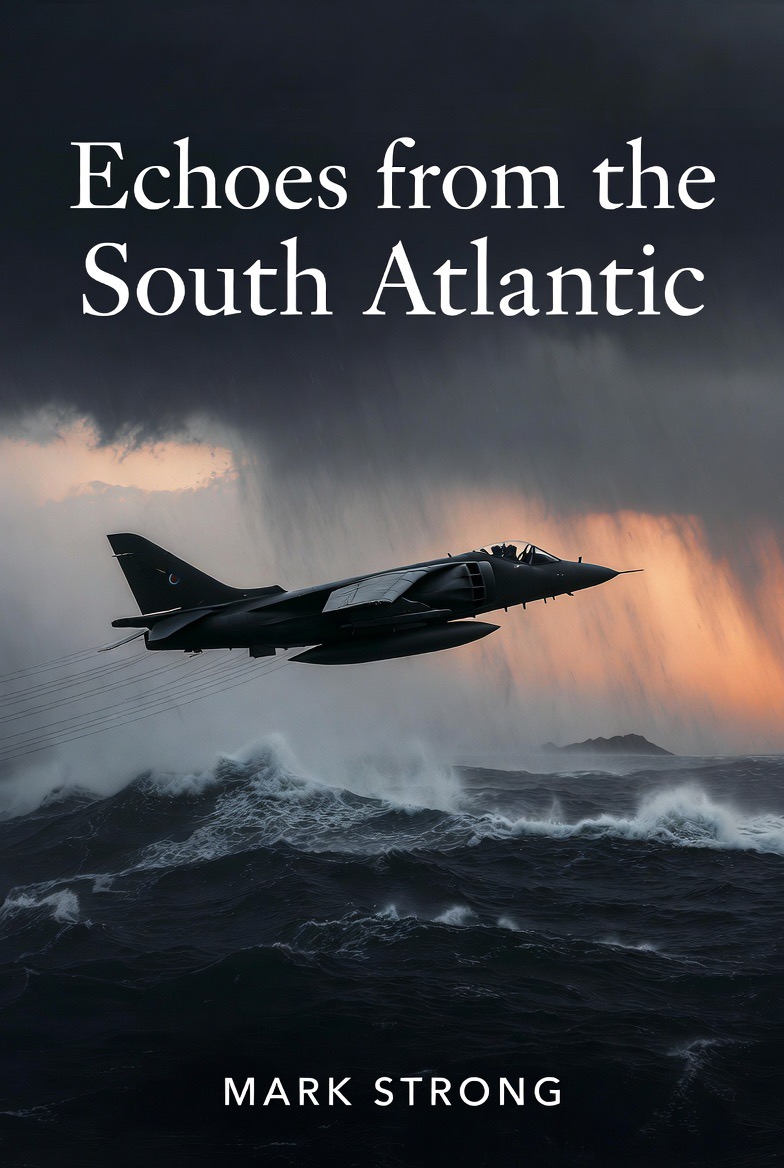
AVAILABLE ON KINDLE
An alternate history novel by Mark (Emperor Markus).
emperormarkus
Ready for Battle?
Explore strategy games, military history, and retro-inspired campaigns built for players who love tactical warfare and immersive storytelling.